
Freed from → robustness-as-one-number and charting-crypto-on-its-own-clock.
In the H/Rindex paper we studied ways to benchmark cryptocurrencies — normalizing hashrate across hashing algorithms into Hindex (the Hashing-Power Index), then measuring resilience as Rindex (the Robustness Index), introduced here in simplified form.
In the crypto universe it boils down to one word: security. Many factors drive adoption and price — algorithm, supply, speed, cost, privacy, smart contracts — but every other factor’s value decays toward zero if a network’s security is compromised for long. Measuring how well a system resists attacks like double-spending is the genesis block of any valuation framework.
Consensus 51% attack resistance
The consensus mechanism that keeps a distributed ledger in agreement is the same mechanism a cartel controlling ≥51% of hashing power can turn to destructive ends. The classic argument said rational miners wouldn’t bother. But with margin trading, shorts and futures, the attack is now financially beneficial: short the instrument, then break the network.
Definition. The 51% attack cost is what it would cost to control 51% of a network’s hashing power — the hardware to generate that hashrate, plus the running cost of electricity.
Index construction
Each constituent’s robustness is its 51% attack cost as a percentage of the total across all constituents. The result is an index weighted by how hard each network is to break rather than by market capitalization.
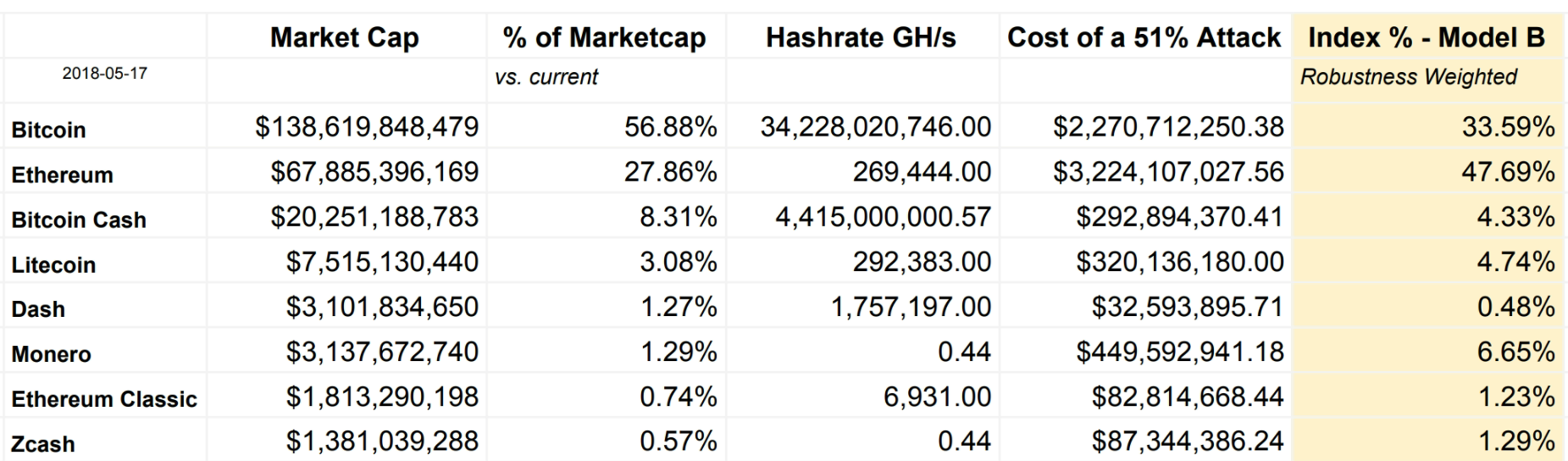 Market-cap-weighted index versus Rindex — the same market, re-weighted by
robustness.
Market-cap-weighted index versus Rindex — the same market, re-weighted by
robustness.
A universe with its own nature
The closest transvaluation of intrinsic value in crypto is computational power — the capacity of decentralized nodes to maintain consensus and stay secure. Rindex proposes robustness-weighting as an alternative to market-cap weighting; blockframe makes the parallel argument for the time axis.